

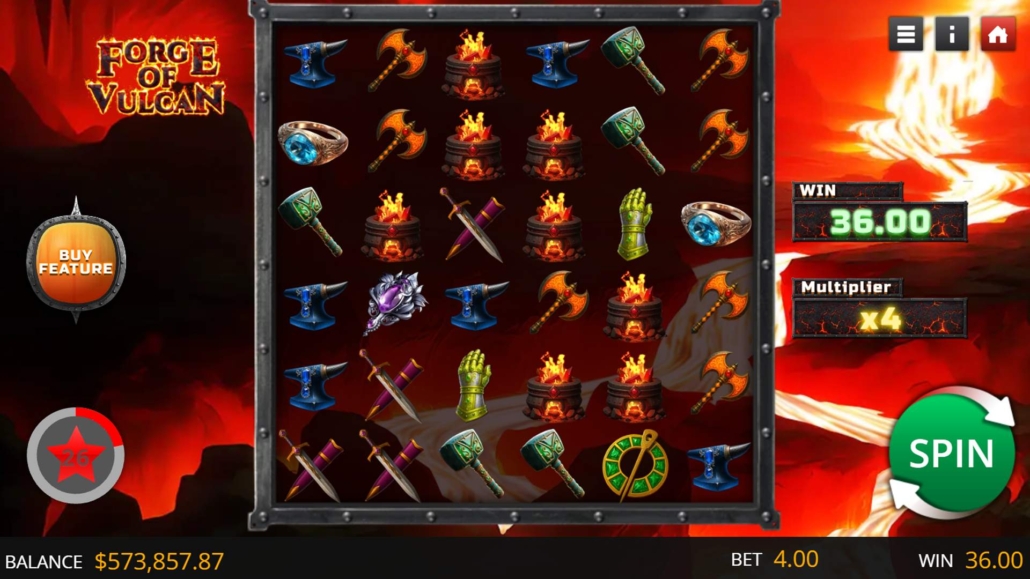
Forge of Vulcan Math & Cascading Mechanics | Lotus Asia
Forge of Vulcan math – Forge of Vulcan: High-Volatility Cascading Mechanics Explained

Forge of Vulcan math at Lotus Asia. Discover the cascading volatility and exponential multipliers that define the mathematical architecture of Forge of Vulcan at Lotus Asia.
For the serious player—the strategist who looks past the flashing lights and seeks the mathematical heart of a machine—Forge of Vulcan offers a compelling proposition. This isn't just a game of myth; it is a game of cascading volatility and exponential multipliers. This technical breakdown explores the engine behind the embers, analyzing how the game's mechanics work together to create a high-ceiling reward structure.
Table of Contents
- The Mathematical Architecture
- The Cascading Engine & Symbol Weighting
- Multiplier Dynamics: The 500x Ceiling
- Bonus Round Analysis: Free Falls
- Technical Data Sheet
- Optimization Strategies
- Technical FAQ
- Final Verdict

The Mathematical Architecture
Forge of Vulcan is built on a 5-reel, 20-line framework, but its complexity arises from its non-linear payout potential. Unlike traditional slots where each spin is an isolated event, the cascading mechanic introduces a "chaining" effect. This means the RTP (Return to Player) is realized through clusters of wins rather than singular, static events. The game is designed for players who prefer high-variance gameplay, where the volatility is balanced by the ability to chain wins through the removal of winning symbols.

The Cascading Engine & Symbol Weighting
The "Cascade" feature is the core driver of the game's volatility. When a winning combination is formed:
- Symbol Dissolution: The winning symbols are removed from the grid.
- Gravity Mechanic: New symbols descend from the top of the reels to fill the voids.
- Re-evaluation: The new configuration is immediately checked for new winning combinations.
This creates a "multiplier-ready" environment. The symbol hierarchy is clearly defined, with the Vulcan Scatter acting as the primary volatility driver. The low-tier symbols (rings, brooches, pins) provide the "base" for cascades, while high-tier symbols (Sword, Axe, Anvil, Furnace, Hammer) provide the heavy-hitting payouts.
Multiplier Dynamics: The 500x Ceiling
The most critical component for high-stakes players is the Cumulative Multiplier. In many slots, multipliers reset after every win. In Forge of Vulcan, the multiplier is designed to build.
With a ceiling of 500x, the game utilizes an escalating math model. This means that the value of a win is not just determined by the symbol combination, but by its position in the sequence. A win occurring later in a cascade chain is significantly more valuable than the initial win, creating a "snowball effect" that can lead to massive payouts from relatively small initial bets.

Bonus Round Analysis: Free Falls
The Free Falls mode is where the game's mathematical ceiling is most frequently tested.
- Trigger: 3+ Vulcan Scatters.
- Quantity: Up to 20 Free Falls.
- Multiplier Synergy: The cumulative multiplier carries through the Free Falls, but because the cascade potential is heightened during this mode, the multiplier climbs much faster.
The mathematical advantage of the Free Falls is the synergy between the unlimited cascade potential and the 500x multiplier cap. This creates a "power law" distribution of wins, where the majority of the game's total payout potential is concentrated within the Free Falls rounds.
Technical Data Sheet
| Parameter | Value |
|---|---|
| Layout | 5 x 3/4 Variable |
| Paylines | 20 Fixed |
| Mechanism | Cascading Wins / Tumbles |
| Scatter Symbol | Vulcan (Triggers Free Falls) |
| Max Multiplier | 500x (Cumulative) |
| Max Bonus Spins | 20 |
| Win Direction | Left-to-Right (Scatters: Any) |

Optimization Strategies
To maximize efficiency in Forge of Vulcan, players should consider the following:
- Volatility Buffering: Because the game is high-volatility, use a "fractional betting" approach. Allocate your bankroll to withstand long periods of low activity to ensure you are present for the high-multiplier cascades.
- Focus on the Cascade Chain: The goal is not just to hit a symbol, but to hit a symbol that initiates a cascade. The "value per spin" increases exponentially as the cascade chain grows.
- Free Fall Maximization: The Free Falls mode is the primary objective. Any strategy should be geared toward reaching the bonus, as the cumulative multiplier is most effective when the reel turnover is high.
Technical FAQ
Q: How does the cumulative multiplier reset?
A: The multiplier typically resets after a full cycle of cascades or at the conclusion of a bonus round, depending on the specific session state.
Q: Is the 500x multiplier additive or multiplicative?
A: The multiplier is applied to the total win of the cascading sequence, acting as a massive force multiplier for the accumulated symbol values.
Q: What is the difference between a Payline win and a Scatter win?
A: Payline wins require symbols to align on one of the 20 specific paths from left to right. Scatters (Vulcan) pay out regardless of their position on the reels and act as the trigger for the bonus engine.
Q: Does the cascading mechanic affect the multiplier?
A: Yes, the cascading wins are the primary method by which the cumulative multiplier is increased.
Q: Can I win more than the maximum coin limit?
A: The maximum payout is capped at xx,xxx coins, which is the theoretical limit of the game's math model.
Final Verdict
Forge of Vulcan is a sophisticated high-volatility slot. It is mathematically engineered to reward players who can navigate the volatility and capitalize on the cascading multiplier mechanics. For those looking for a game with a high ceiling and deep mechanical complexity, this is a top-tier choice.
Analyze the reels. Master the forge. Secure your win.