

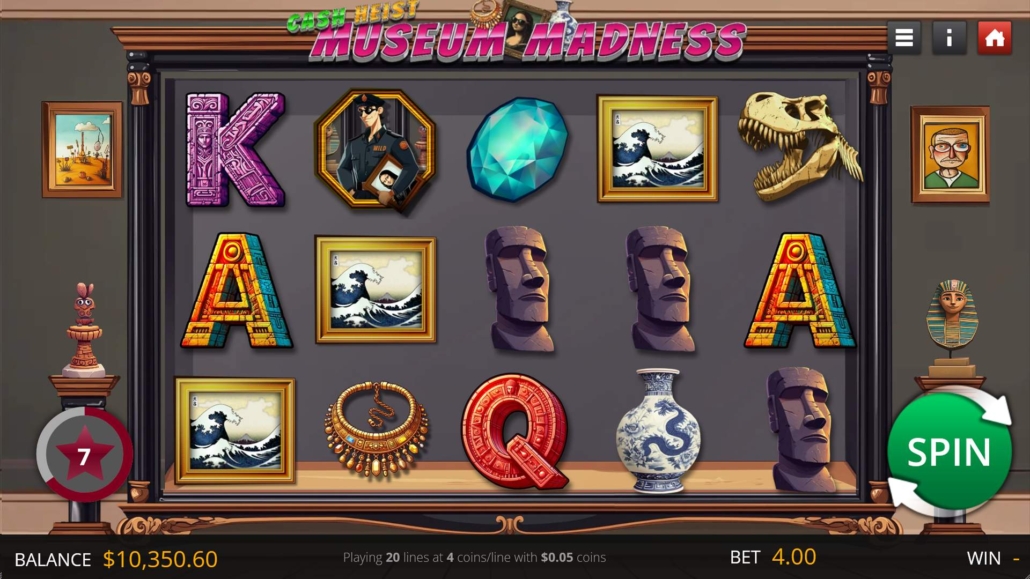
Cash Heist Museum Madness Slot: Technical Deep-Dive by Lotus Asia
The Math Behind Cash Heist Museum Madness Slot at Lotus Asia

For analytical players, the Cash Heist Museum Madness slot at Lotus Asia offers a masterclass in feature-driven volatility and strategic gameplay.
For the analytical player, the thrill of a slot machine isn't found in the flashing lights, but in the underlying mathematics, the volatility profiles, and the mechanical synergy of its features. Cash Heist Museum Madness is a masterclass in feature-driven volatility. This isn't a "cookie-cutter" slot; it is a multi-layered engine designed to reward strategic selection and high-momentum gameplay.
In this deep-dive, we strip away the cartoon veneer to examine the mechanics that make this the third (and perhaps most complex) entry in the Cash Heist series.
Index
- Engine Analysis: Mechanics and Structure
- Feature Synergy: Multipliers vs. Accumulators
- The Statistical Breakdown
- Quantitative Strategy: Optimizing Returns
- Technical FAQ
- Final Analysis

Engine Analysis: Mechanics and Structure
Cash Heist Museum Madness operates on a 5×3 grid with 25 fixed paylines. However, the "engine" of the game is driven by its Scatter-triggered branching paths.
The core architecture relies on the Rosetta Stone (Feature Scatter). Upon triggering 3+ Scatters, the player enters a decision phase. This is a critical distinction in slot design: it introduces player agency into the volatility equation. You aren't just playing a randomized sequence; you are selecting a mathematical model (either a Multiplier-based model or an Accumulator-based model) that suits your preferred variance.

Feature Synergy: Multipliers vs. Accumulators
The game offers two distinct mathematical experiences through its bonus rounds. Understanding the synergy between symbols is key to understanding the game's ceiling.
The Multiplier Engine (Freespins)
The Freespins mode is built on Exponential Growth. The primary driver is the Jimmy (Security/Janitor) Wild.
- The Trigger: Landing a Wild.
- The Effect: A simultaneous increase in the Spin Count and the Win Multiplier.
This creates a "compounding interest" effect. As the multiplier climbs, the value of subsequent Wilds increases, which in turn provides more spins, extending the period during which high-multiplier wins can occur. This is a high-variance mechanic designed for massive "runaway" wins.
The Accumulator Engine (Superspins)
The Superspins mode shifts the focus from multipliers to Static Value Accumulation.
- The Prize Symbol: This is a "sticky" symbol that stays on the reel. It introduces a new layer of math: the Accumulated Value Model. Instead of multiplying a win, the game is building a pot.
- The Extra Spin Symbol: This acts as a volatility buffer, mitigating the risk of a short feature by injecting additional spin opportunities.
The Superspins mode is designed for players seeking a concentrated, high-impact payout where the "weight" of the symbols on the reels increases as the feature progresses.
The Statistical Breakdown
For the data-driven enthusiast, here is the technical breakdown of the game's parameters.
Core Specifications
| Parameter | Data |
|---|---|
| Grid Configuration | 5 Reels, 3 Rows |
| Payline Count | 25 Lines |
| Maximum Payout Ratio | 62,500x |
| Winning Logic | Left-to-Right (Standard) / Any Direction (Scatters) |
| Wild Functionality | Substitution & Feature Progression (Multiplier/Spin Boost) |
Symbol Hierarchy & Utility
| Symbol Category | Primary Function | Mathematical Impact |
|---|---|---|
| Wild (Jimmy) | Substitution | Triggers Multiplier/Spin increments |
| Feature Scatter | Trigger | Opens branching bonus paths |
| Prize Symbol | Accumulation | Increases total payout at feature end |
| Extra Spin | Extension | Increases feature duration |

Quantitative Strategy: Optimizing Returns
While all slot outcomes are governed by RNG (Random Number Generation), a professional approach to Cash Heist Museum Madness involves understanding the "Volatility Pivot."
- The Multiplier Pivot: If your goal is to maximize the "ceiling" of a single session, the Freespins mode with increasing multipliers is mathematically superior for catching a "runaway" win. Focus on high-value symbol combinations that can be amplified by the climbing multiplier.
- The Accumulation Pivot: If you prefer a more predictable buildup of value, the Superspins mode is the target. The presence of "sticky" Prize Symbols means that the value of the feature is tied to the duration and density of those symbols on the reels.
- Volatility Management: Given the 62,500x max win, expect significant swings. A "Staircase Betting" approach (adjusting bet sizes based on feature frequency) can help manage the bankroll during the dry spells between Rosetta Stone triggers.
Technical FAQ
Q: How do Scatters pay out compared to paylines?
A: Payline wins are multiplied by the credits wagered per line. Scatter wins are multiplied by the total credits wagered, making them significantly more impactful to the total return.
Q: Does the "Extra Spins" symbol work in all modes?
A: No, the Extra Spins (Scatter) symbol is a specialized mechanic that appears specifically during the Superspins mode to extend the accumulation period.
Q: What is the maximum possible win?
A: The game is capped at a maximum payout of 62,500 Coins.
Q: Are the Wild symbols the same in both Freespins and regular play?
A: The Wilds function as standard substitutes in regular play, but they gain "Feature Functionality" during Freespins, where they actively increase the multiplier and spin count.
Q: How many Feature Scatters are required for the bonus?
A: A minimum of 3 Rosetta Stone symbols is required to activate the feature selection menu.

Final Analysis
Cash Heist Museum Madness stands out in a crowded market due to its sophisticated feature-selection mechanics. By separating the "Multiplier" experience from the "Accumulator" experience, the developers have created a game that appeals to two different mathematical profiles. It is a high-volatility, high-reward title that rewards the player's understanding of its unique internal logic.
Conclusion
The math is clear: the potential for a 62,500x payout is driven by the synergy of Wilds, Multipliers, and Sticky Prize Symbols. The question is not if the heist can succeed, but whether you have the strategic discipline to ride the volatility to its peak. Analyze the reels, choose your path, and execute the perfect heist now!